Summer guests don't have to be one-time visitors. See how hotels use segmentation and win-back campaigns to turn guests into repeat direct bookings.
Your busiest season just sent a wave of guests through your doors, and plenty of them could become regulars if you give them a reason to come back. A hotel win-back campaign is how you do exactly that: a short, automated sequence that re-engages guests who haven't returned and turns a one-time summer stay into a repeat, direct booking.
Autumn is the perfect moment to run one. Here's how. And if you'd rather have a hand setting it up, you can schedule a call with our team any time.
What is a hotel win-back campaign?
A win-back campaign is a series of personalised messages sent to guests who have stayed before but haven't returned within the window you'd expect. The goal is simple: remind them why they loved their stay, give them a warm reason to rebook, and reach them directly, so the next booking comes to you rather than through a third party.
The best win-back campaigns aren't a single "we miss you" email. They're a short, automated sequence, triggered by guest behaviour and tailored to who each guest is and what they enjoyed last time.
Why is post-summer the moment to act?
Because you're holding a large, fresh pool of recent guests just as the autumn and festive booking window opens. Two things are true at once as the season winds down: you've welcomed guests you may never have spoken to directly (anyone who booked through an OTA, especially), and travellers are starting to plan breaks, celebrations and getaways.
Wait until December and that summer goodwill has gone cold. Reach out in September and October, and you're catching guests while the memory of their stay is still warm, and getting there well ahead of your festive and Black Friday campaigns.
How do you decide which guests to win back?
You can't win back guests you can't see, and this is where Recency, Frequency, Monetary (RFM) segmentation earns its keep. RFM scores every guest on three things: Recency (how recently they stayed), Frequency (how often), and Monetary value (how much they spend). Together, those scores tell you who's slipping away and who's worth the effort.
For a post-summer win-back, you're looking for guests with strong frequency or spend but declining recency: the people who used to come back but haven't lately. A guest who spent well and stayed twice last year is far more valuable to re-engage than a one-night bargain-hunter who booked purely on price.
With a CRM that unifies guest data from your PMS, booking engine and other systems into one profile, this segmentation happens automatically. No spreadsheets, no manual list-building. You already have the data you need to act!
What does a good win-back sequence look like?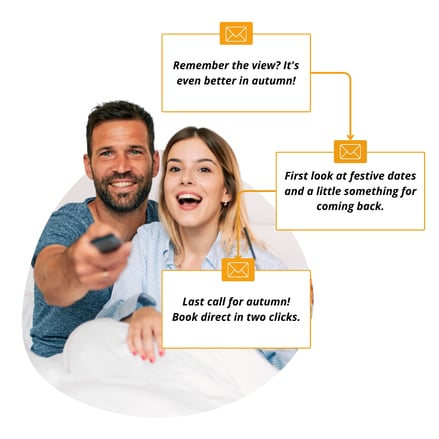
A practical post-summer sequence might run like this:
- The warm reminder. Lead with the experience, not a discount. Reference what they loved, whether that's the spa, the restaurant or the view, and invite them back for autumn. This is your chance to build some excitement before you ever mention a rate. If you have other properties in your portfolio, this could be a good opportunity to introduce them!
- The reason to rebook. A few days later, add value: an autumn package, a midweek escape, early access to festive dates, or a loyalty perk personalised to their last stay. If you run a loyalty programme, this is the natural place to bring guests back into it. For-Sight's Guest Loyalty module makes those rewards automatic and card-linked, so returning guests feel recognised without any manual effort from your team.
- The gentle nudge. A final message with a little light urgency, such as limited autumn availability or festive dates filling up, and a direct booking link.
Every message should point to your own booking channel, not an OTA. That's the whole point: a guest you win back directly is a guest whose relationship you own, and one you never have to pay commission on again. It's how a single stay becomes Repeat Visits.
Why are won-back guests your most profitable bookings?
Re-engaging a guest you already have is consistently cheaper and more profitable than chasing a brand-new one. Even a small lift in retention can lift profits substantially, because repeat guests book more directly, spend more on extras, and cost far less to reach.
Win-back campaigns also reduce your hotel's reliance on OTA bookings. Most independent hotels pay 15% to 25% on every OTA booking. Win them back direct, and you keep that margin every time they return.
Not sure what OTAs are actually costing you? Run your numbers through our OTA calculator and see what shifting even a small share direct could be worth.
This is exactly what For-Sight is built for. Feversham Arms Hotel & Verbena Spa saw a 3,045% return from a four-email campaign. Bridgewood Manor grew direct bookings by 52% through targeted, data-driven guest engagement. Same principle every time: know your guests, reach the right ones, and bring them back on your terms. And you don't have to build it alone. Helping hotels get campaigns like this live is exactly what our team does day to day.
Get your win-back campaign live this autumn
The guests are already in your database. The tools to reach them are ready. The only real question is whether you get to them while that summer stay is still fresh.
Winning back lapsed guests is one of the most cost-effective ways to fill your calendar, and it's especially powerful in the months when occupancy dips. If you're planning ahead for the quieter season, it's worth understanding why shorter booking lead times and the rise in domestic travel make November through February a genuine opportunity rather than a write-off. There are plenty of practical campaign ideas to inspire bookings exactly when you need them most, from bring-back and staycation offers to packages that go beyond the room. For a natural next read, take a look at our guide on how to drive revenue during the low season with these campaigns.
Frequently asked questions
What is a win-back campaign in hospitality?
A win-back campaign is an automated series of personalised messages sent to past guests who haven't returned within an expected timeframe. It's designed to re-engage them and drive a repeat booking, ideally a direct one, so the hotel keeps both the margin and the guest relationship.
How do hotels identify lapsed guests?
Most use RFM segmentation, scoring guests on recency, frequency and monetary value. Lapsed guests are those whose recency has dropped despite previously booking often or spending well. A CRM that unifies PMS and booking data can flag them automatically, with no manual list-building.
When should a hotel send a win-back campaign?
As soon as there's a clear pool of recent, non-returning guests. Post-summer is ideal for independent hotels: it reaches guests while their stay is still fresh, and gets ahead of the autumn, festive and Black Friday booking windows.
Why are direct rebookings better than OTA rebookings?
Direct bookings avoid the 15% to 25% OTA commission. Just as important, you own the guest relationship, so you can invite the same guest back again and again without paying a third party to reach them each time.
Can win-back campaigns be automated?
Yes. With a hotel CRM and marketing automation, win-back sequences are triggered by guest behaviour and personalised at scale, so they run in the background without adding to your team's workload.