Blog
Hotel CRM Software: 8 Questions to Ask Before You Buy in 2026
Choosing hotel CRM software in 2026? 8 questions to ask on guest data, PMS integration, direct bookings, cost and support.
How a hotel unlocked continuous ancillary revenue streams and reclaimed staff time by replacing manual campaigns with automated journeys made in For-Sight.
The Diamond Coast Hotel is an independently owned 4-star hotel on Ireland's Wild Atlantic Way. A proud member of the TMR Hotel Collection, it sits in Enniscrone, County Sligo, overlooking Killala Bay and the renowned Enniscrone Golf Course- with 99 beautifully appointed bedrooms, two venues in the Coral Restaurant and Inishaven Bar, and a guest mix spanning golfers, families and couples throughout the year.
Like many independent hotels, Diamond Coast had a rich stream of guest data and a small team with no time to act on it manually. This is the story of how they turned that data into a self-running ancillary revenue engine, saving over 70 staff hours and replacing 100 manual campaigns.
In a highly competitive hospitality landscape, relying on manual outreach or generic bulk sends costs revenue, engagement and time. For Diamond Coast, three problems were compounding:
💸Missed revenue opportunities: Guests received no timely touchpoints before, during or after their stay.
✉️Generic, one-size-fits-all messaging: A single bulk email couldn't speak to golfers, families and couples differently, so engagement suffered.
🕓 Heavy manual workload: Every campaign was built and sent by hand, a cost a small team simply couldn't keep absorbing.
The result was a familiar one for independent hoteliers: valuable guest relationships going cold, and a marketing calendar dictated by whoever had a spare hour to build and send.
Diamond Coast transitioned to a fully automated, data-driven lifecycle marketing strategy powered by For-Sight- turning everyday guest interactions into a scalable, revenue-generating engine.
Lifecycle marketing automation is the practice of triggering personalised guest communications automatically at each stage of the guest journey (from booking, to pre-arrival, to post-stay, to re-engagement) based on guest data rather than manual scheduling. Instead of a marketer building and sending each campaign by hand, the campaign workflow runs continuously in the background. A guest enters a segment, the right message is sent at the right moment, and the resulting revenue is tracked back to the journey that produced it.
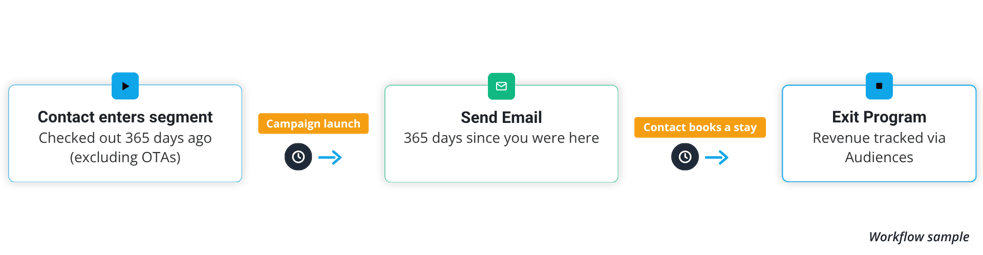
At Diamond Coast, that same engine powers every stage of the guest lifecycle, over 6,800 communications, entirely hands-free. Each segment, built on guest behaviour, booking source and stay stage, gets its own automated journey.
-3.png?width=1920&height=500&name=Untitled%20design%20(22)-3.png)
Every stage of the guest lifecycle now works on its own, and (crucially) each journey is tracked to the ancillary revenue it generates. Over the 90-day measurement period, four journeys delivered:
Two journeys are worth a closer look, because they show how the same data foundation serves very different goals.
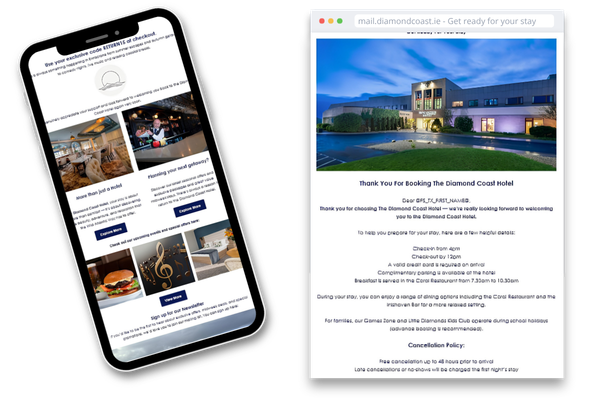
Triggered before arrival, this journey generated €630 while quietly doing the hotel's admin for it. It worked because it:
Triggered after departure, this re-engagement journey is designed to bring past guests back through the direct channel. It works because it:
That last point matters more than the modest €139 figure suggests. Every guest recovered into the direct channel is a guest the hotel no longer pays commission on- and with online travel agency commissions widely reported at 15–30% of booking value (PhocusWright, 2025), the compounding saving on repeat direct stays far outweighs the first-touch revenue.
The numbers tell a clear story about both performance and efficiency.
.png?width=1118&height=404&name=Diamond%20Coast%20Hotel%20%E2%80%94%20For-Sight%20Case%20Study%20(1).png)
The takeaway: strong data and set-up show up in that 96% delivery rate, and a 33.1% open rate shows guests genuinely welcome what arrives. Right timing plus relevant messaging is what turns an email programme from noise into revenue.
This campaign progressed several elements of the For-Sight Customer Success Program, including new segmentation (Mosaic, RFM and points bands), automated journeys, OTA reduction and early loyalty improvements. The rest form the roadmap for what comes next:
Building on a solid guest-data foundation, the plan is to keep moving the value ladder upward, deepen personalisation, and reward the segments that matter most.
"We've had a very positive experience using For-Sight. The platform is incredibly user-friendly, making it easy to access guest data, build targeted segments, and create effective marketing campaigns. The reporting and accessibility of the data have given us valuable insights into our customers and helped us deliver more personalised communications. The support we've received throughout our journey has been excellent, with the team providing expert guidance, prompt assistance, and helping us maximise the value of the platform. A special mention goes to Malwina, who has been a wonderful support throughout."

Every result in this story was powered by one thing: For-Sight, the hospitality CRM built to turn guest data into direct revenue. Diamond Coast didn't add another disconnected tool. They put a single, intelligent platform at the centre of their marketing, working across the full guest lifecycle. Here's how it comes together, across the three principles that drive everything For-Sight does: Know, Delight, Repeat.
Ready to turn your guest data into a continuous revenue stream? Schedule a call and see how For-Sight can help you know your guests, craft delightful experiences, and earn repeat visits.
Choosing hotel CRM software in 2026? 8 questions to ask on guest data, PMS integration, direct bookings, cost and support.
The Hotel Marketer's Guide to Guest Segmentation: A practical framework that powers relevant, automated communication and better stays.
Hotel PMS vs CRM explained: the key differences and why pairing a CRM with a PMS helps hotel marketers to market smarter and drive more direct...