Blog
Hotel CRM Software: 8 Questions to Ask Before You Buy in 2026
Choosing hotel CRM software in 2026? 8 questions to ask on guest data, PMS integration, direct bookings, cost and support.
The Hotel Marketer's Guide to Guest Segmentation: A practical framework that powers relevant, automated communication and better stays.
When it comes to making a successful campaign, who you send your email to is just as important as coming up with an intriguing subject line and a valuable offer.
In our previous blog, we talked about the importance of setting the right goals and actions for your campaigns. This month, we’re focusing on how guest segmentation can help you send the right message to the right people. Guest segmentation is the practice of grouping your guests by shared behaviours or characteristics, so you can communicate with each group in a way that actually resonates.
The campaign tactics you’ll use for your goal will vary depending on whom you’re talking to. For example, locals and loyal visitors know the area, while first-timers and faraway travellers may need more guidance, so what they need to know will differ. Going even further, your approach for promoting property amenities for couples is going to look different from your approach for families with children. Families will be more interested in the pool, whereas couples want to hear about the seasonal tasting menu and spa packages.
For hotel marketers, segmentation can be the difference between a campaign that drives real bookings and one that gets ignored. This guide covers the segmentation models that matter most in hospitality, the guest groups worth prioritising, and how to make it all work in practice.
Guest segmentation means dividing your database into meaningful groups so you can speak to each one differently. Not every guest wants the same thing. A couple celebrating their anniversary has different motivations and triggers than the family that visits you twice a year or a first-time visitor who discovered you through Booking.com.
Here are four common examples of segmentation that matter in hospitality:
One-size-fits-all email campaigns don’t work, and most hotel marketers already know it! Campaign Monitor's research finds that marketers using advanced segmentation see a 760% increase in revenue compared to non-segmented sends.
That’s a huge difference! For a hotel sending the same campaign to 10,000 contacts, the difference between an unsegmented and well-segmented campaign can have a big impact on your bottom line.
But you shouldn’t just think about gaining additional revenue; segmentation is a smart way to get more value from your guest data. Research consistently shows it costs 15–20 times more to acquire a new hotel guest than to re-engage an existing one. Between 2022 and 2025, hotel customer acquisition costs surged by over 35%, while guest lifetime value crept up by just 4.5% (Adobe, 2025). That gap is where segmentation really shines — by making the most of the contacts you already have, rather than constantly chasing new ones.
.png?width=479&height=318&name=For-Sight%20Overview%20-%20Mar%202026%20(1).png)
We’ve gone over this before in The Power of Personalisation, but your guests are expecting personalised messaging. Twilio's 2025 State of Customer Engagement Report, based on a survey of over 7,600 consumers globally, found that while 75% of businesses report increased spend from personalisation efforts, only 45% of consumers actually feel understood by the brands they interact with.
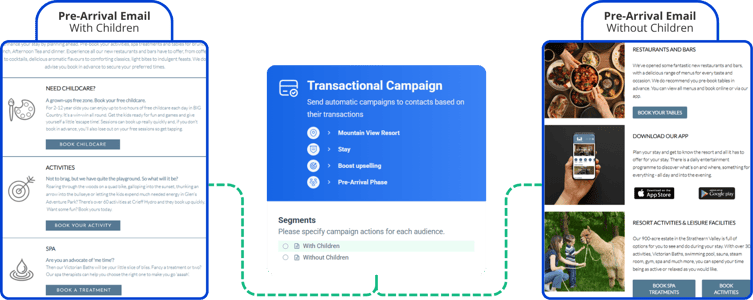
One of the simplest ways hoteliers can use segmentation to create personalisation is during the pre-arrival phase. This campaign example shows slightly altered messaging for first-time stayers and return visitors, with an extra bonus for those loyal guests.
Segmentation isn’t a shortcut to creating personalised campaigns that convert into revenue, but it is one of the most direct ways to set your campaigns up for success.
You don't need dozens of segments to get meaningful results. For most independent hotels, six to seven well-defined groups — built from your existing data — are enough to transform your marketing output. Start with one of these segments to really see the benefits of a segmented campaign!
RFM is the backbone of intelligent hotel marketing because it clearly defines who the most important guests to your hotel are, using these factors:
When you score your entire database on these three dimensions, patterns emerge. Your top-scoring guests (high on all three) are your most valuable and most engaged. Guests with high frequency and monetary scores but low recency are lapsed VIPs: the clearest possible win-back target. Guests with low scores across all three are unlikely to convert and probably shouldn't be the priority for your next campaign.
For revenue managers, RFM is more than a marketing tool. It connects guest behaviour directly to revenue outcomes, making it possible to understand not just who is booking, but what those bookings are worth over time.
Segmentation is only as good as the data behind it. Three things are essential:
For-Sight's Guest Intel & Segmentation is built specifically for this. It connects directly to your tech stack (including PMS, spa, wifi, golf, and loyalty programmes), pulling guest data into unified profiles that update in real time. RFM scoring is built in with segments evolving as guest behaviour changes, so you're always working with live data, not a static snapshot. From those segments, you can build and deploy campaigns through your existing marketing channels without the manual overhead. The result is communication that feels personal because it's based on what your guests actually do.
Choosing hotel CRM software in 2026? 8 questions to ask on guest data, PMS integration, direct bookings, cost and support.
Hotel email personalisation doesn’t just mean writing a different message for every guest. Here's how you use your data to deliver smarter campaigns!
Hotel PMS vs CRM explained: the key differences and why pairing a CRM with a PMS helps hotel marketers to market smarter and drive more direct...